Speculative decoding is one of the most widely discussed inference optimizations in recent LLM engineering, and frequently one of the most misunderstood. The core proposition sounds ideal: achieving a 2–3× boost in decoding throughput with mathematically identical output distributions—yielding performance gains via a lightweight secondary model.
In practice, speculative decoding functions as a trade-off rather than a guaranteed acceleration: you pay the computational overhead of running a smaller draft model with the expectation that its outputs align sufficiently with the target model to yield a net speedup.
This post details the complete system stack—covering core transformer architecture, memory bandwidth constraints, the draft-then-verify loop, state-of-the-art methodology taxonomies, and empirical benchmark evaluations on GPT-2 weights—to highlight where performance gains originate and where they risk regressing.
---
Executive Summary
- Autoregressive Decoding is Serial & Memory-Bound: Single-token autoregressive generation is limited by memory bandwidth during low-batch inference. Speculative decoding directly targets this single-stream latency bottleneck.
- The Core Mechanism is Draft-Then-Verify: A fast draft model proposes $k$ candidate tokens sequentially. The target model then verifies all $k+1$ positions in a single parallel forward pass. Rejection sampling preserves the exact target output distribution.
- The Speedup Has a Hard Inequality Constraint ($\alpha > c$): Net performance gains require the draft model's token acceptance rate ($\alpha$) to strictly exceed its relative computational cost fraction ($c$). Failing this condition increases overall latency.
- Architectural Taxonomy: Current approaches (Speculative Sampling, Medusa, EAGLE, Self-Speculative, Lookahead) vary primarily in their draft generation mechanism. End-to-end performance depends directly on draft–target distribution alignment rather than the verification loop itself.
- Empirical Findings: Evaluations on un-aligned weights yielded a speedup of 0.2–0.9× (a net performance penalty). This negative result highlights the operational necessity of validating draft alignment prior to deployment.
---
Visual Overview
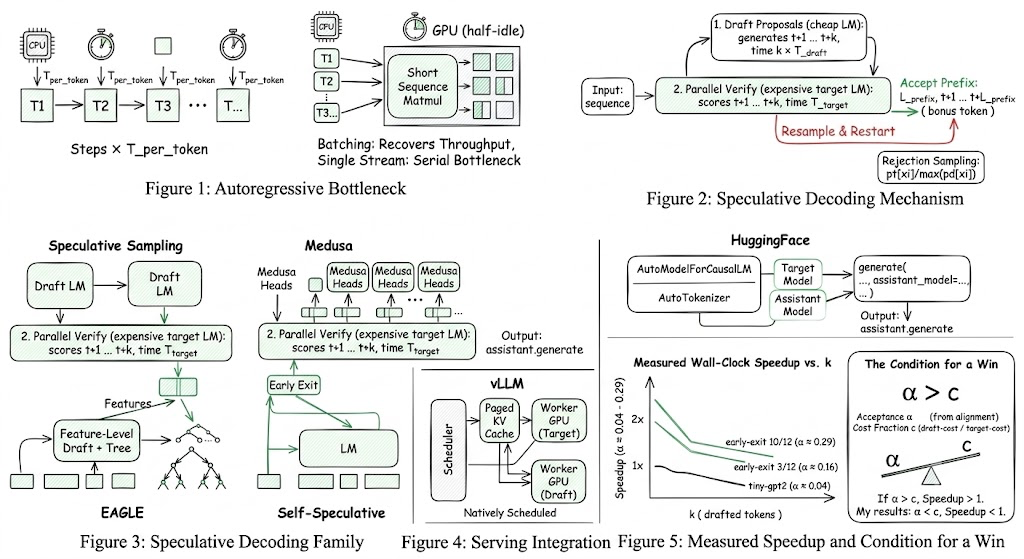
1. Model Setup & Architecture
To evaluate speculative decoding, we must analyze the hardware execution costs of a single forward pass. A causal language model generates next-token probability distributions by executing tensor operations across its transformer stack. This pipeline is bounded by two distinct factors:
- Matrix multiplication operations (GEMM FLOPS across transformer layers).
- Memory bus transfers (fetching model weights and KV-cache states from DRAM to SRAM/registers).
For small batch sizes ($B=1$) on single-stream inference, memory transfers dominate total step latency: compute units execute quickly and subsequently stall while waiting for weight loading. Speculative decoding specifically targets this architectural bottleneck.
[Target Model (Ground Truth): GPT-2 124M]
d_model=768, depth=12, heads=12, Vocab=50k
                       ▲
                       │ (pt)
             ┌───────────────────┐
             │ Target Final Head │
             └─────────▲─────────┘
                       │
             ┌───────────────────┐
             │  GPT-2 (12 Layers)│
             └─────────▲─────────┘
                       │
             ┌───────────────────┐
             │  Input Embeddings │
             └───────────────────┘
Experimental Setup Parameters
- Target Model:
gpt2(124M parameters, 12 layers). - Draft Models:
1. sshleifer/tiny-gpt2 (10M parameters, 2 layers) serving as an independent small LM draft.
2. gpt2 early-exit heads at intermediate layers $m \in \{3, 10\}$ serving as a self-speculative draft.
- Decoding Strategy: Rejection sampling (Chen et al., 2023) at temperature $T = 0.8$.
- Evaluation Metric: Wall-clock output generation rate (tokens/sec) evaluated across benchmark prompts.
- Reproducibility: Benchmarks are programmatically generated via
spec_experiment.py.
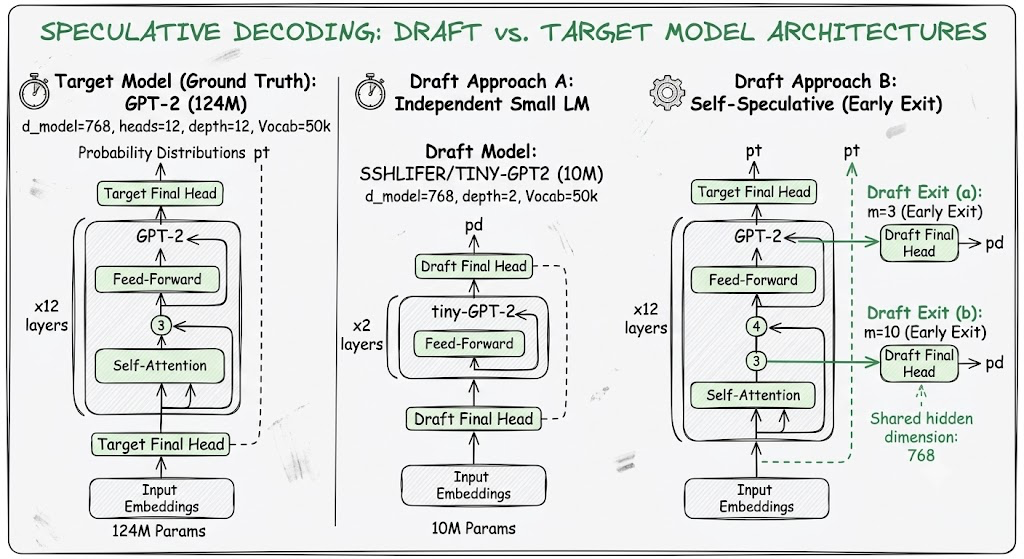
Key Takeaway: A draft mechanism provides net throughput benefits only when it is computationally inexpensive (low layer count/parameter footprint) and statistically aligned with the target distribution.
---
2. The Serial Memory Bottleneck
Transformer architectures process input sequences in parallel during context encoding (prefill phase), but execute sequentially across step iterations during auto-regressive decoding (decoding phase). Token $t_i$ cannot be evaluated until token $t_{i-1}$ is generated, due to causal self-attention dependencies across historic Key-Value (KV) states.
$$\text{Latency}_{\text{autoregressive}} = N_{\text{tokens}} \times t_{\text{per-token}}$$
Panel A: Autoregressive Bottleneck (Serial)
[Step t]  ──(Fetch Weights & KV)──> [Token 1] ──┐
[Step t+1] ──(Fetch Weights & KV)──> [Token 2] ──┼─> High Memory Stall / Idle Compute
[Step t+2] ──(Fetch Weights & KV)──> [Token 3] ──┘

Panel B: Speculative Verification (Parallel)
[Single Forward Pass] ──(Fetch Weights Once)──> [Verify Tokens 1, 2, 3, 4 Simultaneously]
At low batch sizes, single-token generation iterations fail to fully saturate GPU compute pipelines.
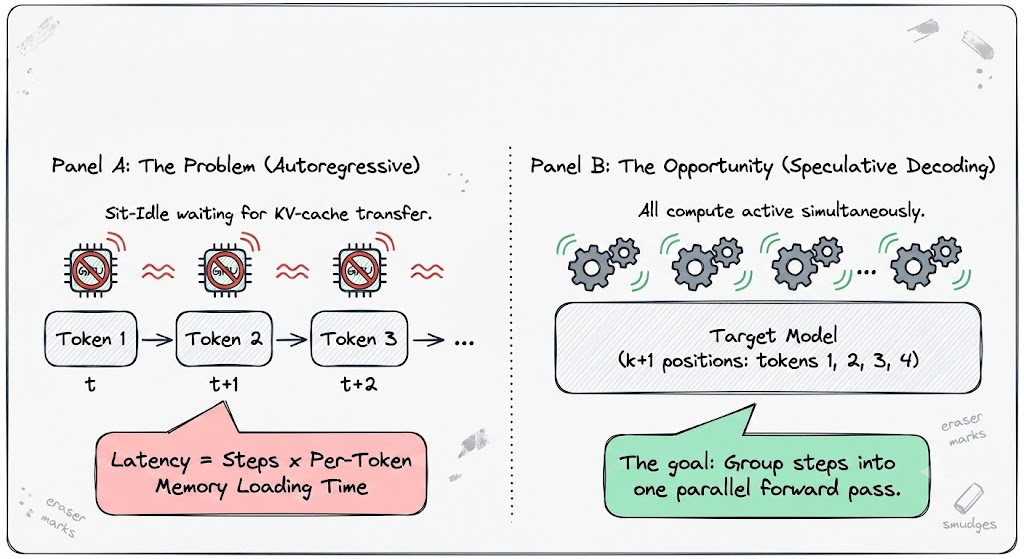
Executing a single target forward pass over a sequence of length $L+k$ requires nearly the same memory bandwidth overhead as executing a forward pass over sequence length $L$. Speculative decoding leverages this invariant by amortizing weight transfer costs across $k+1$ candidate tokens simultaneously.
---
3. The Speculative Sampling Mechanism
The speculative sampling execution pipeline follows a three-step cycle:
- Draft Phase: The lightweight draft model generates $k$ candidate tokens sequentially: $$\hat{x}_{1}, \hat{x}_{2}, \dots, \hat{x}_{k} \sim p_{d}(x \mid \text{context})$$
- Verification Phase: The target model processes the concatenated sequence $\text{context} \cup \{\hat{x}_{1} \dots \hat{x}_{k}\}$ in one forward pass, computing target logits for all $k+1$ token positions in parallel.
- Correction Phase: Rejection sampling is applied sequentially across candidate tokens. The first rejected token $\hat{x}_i$ is resampled from the corrected residual distribution: $$p_{\text{adjusted}}(x) = \text{relu}\left(p_{t}(x) - p_{d}(x)\right)$$
This mathematical formulation guarantees that the final output distribution remains provably identical to sampling directly from the target model.
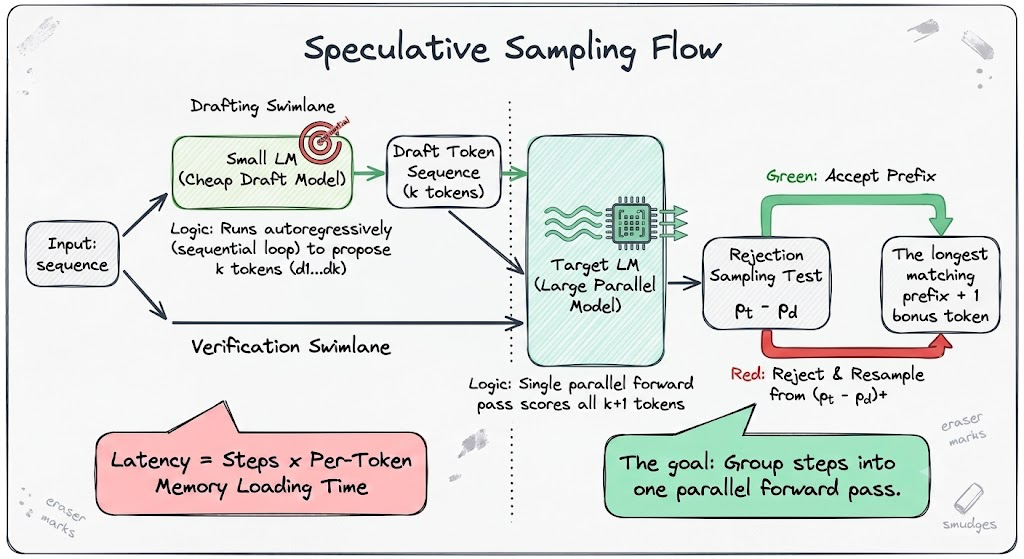
Sampling & Rejection Implementation
import torch
import torch.nn.functional as F

def spec_sample(seq, k, draft_fn, target_fn, temp=0.8):
    """
    Executes speculative decoding with exact target distribution preservation.
    """
    draft_tokens, draft_logits = [], []
    current_seq = list(seq)

    # 1. Draft Step: Generate k candidates sequentially
    for _ in range(k):
        logits = draft_fn(current_seq)
        next_logit = logits[-1]
        draft_logits.append(next_logit)

        token = torch.multinomial(F.softmax(next_logit / temp, dim=-1), 1).item()
        draft_tokens.append(token)
        current_seq.append(token)

    # 2. Verify Step: Parallel validation over k+1 positions
    target_logits = target_fn(seq + draft_tokens)
    prefix_offset = len(seq)
    accepted_count = 0

    # 3. Correction Step: Rejection sampling loop
    for i in range(k):
        pt = F.softmax(target_logits[prefix_offset - 1 + i] / temp, dim=-1)
        pd = F.softmax(draft_logits[i] / temp, dim=-1)
        candidate = draft_tokens[i]

        # Accept condition
        if torch.rand(1).item() < min(1.0, (pt[candidate] / pd[candidate]).item()):
            accepted_count += 1
        else:
            # Reject: Resample candidate from adjusted distribution (pt - pd)+
            residual = torch.clamp(pt - pd, min=0.0)
            residual /= residual.sum()
            resampled_token = torch.multinomial(residual, 1).item()
            return seq + draft_tokens[:accepted_count] + [resampled_token], accepted_count

    # Bonus token sampling if all k drafted tokens are accepted
    bonus_token = torch.multinomial(F.softmax(target_logits[prefix_offset + k - 1] / temp, dim=-1), 1).item()
    return seq + draft_tokens + [bonus_token], k
---
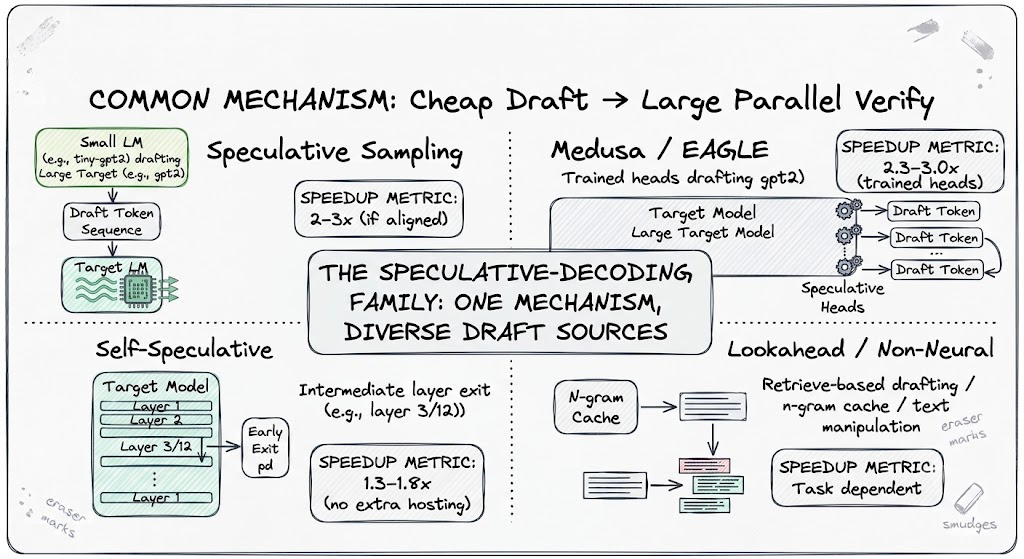
4. The Speculative-Decoding Family
While all speculative decoding variants rely on the same fundamental parallel verification framework, they differ in their structural draft generation mechanisms:
| Approach | Draft Generation Architecture | Target Acceleration | Primary Operational Trade-off |
|---|---|---|---|
| Speculative Sampling | Independent auxiliary Small LM | 2.0–3.0× | Requires hosting separate draft model & tokenizer alignment |
| Medusa | Multi-head prediction heads on target | 2.3–3.0× | Requires parameter fine-tuning of prediction heads |
| EAGLE | Feature-level drafting with tree attention | 2.0–3.0× | High draft acceptance rate; higher system complexity |
| Self-Speculative | Target model internal early-exiting | 1.3–1.8× | Zero additional weight hosting; limited by layer alignment |
| Lookahead | Jacobi iteration / N-gram retrieval | 1.8–2.3× | Parameter-free; highly sequence/task dependent |
Production Framework Integrations
Hugging Face Transformers (assisted_generation)
from transformers import AutoModelForCausalLM, AutoTokenizer

tokenizer = AutoTokenizer.from_pretrained("gpt2")
target_model = AutoModelForCausalLM.from_pretrained("gpt2")
assistant_model = AutoModelForCausalLM.from_pretrained("sshleifer/tiny-gpt2")

inputs = tokenizer("The future of artificial intelligence is", return_tensors="pt")
outputs = target_model.generate(
    inputs.input_ids,
    assistant_model=assistant_model,
    do_sample=True,
    temperature=0.8,
    max_new_tokens=50
)
vLLM Native Scheduler Integration
python -m vllm.entrypoints.openai.api_server \
  --model meta-llama/Llama-3-8B-Instruct \
  --speculative-model meta-llama/Llama-3-1B-Instruct \
  --num_speculative_tokens 5 \
  --max-model-len 4096
---
5. Benchmarking & Empirical Performance
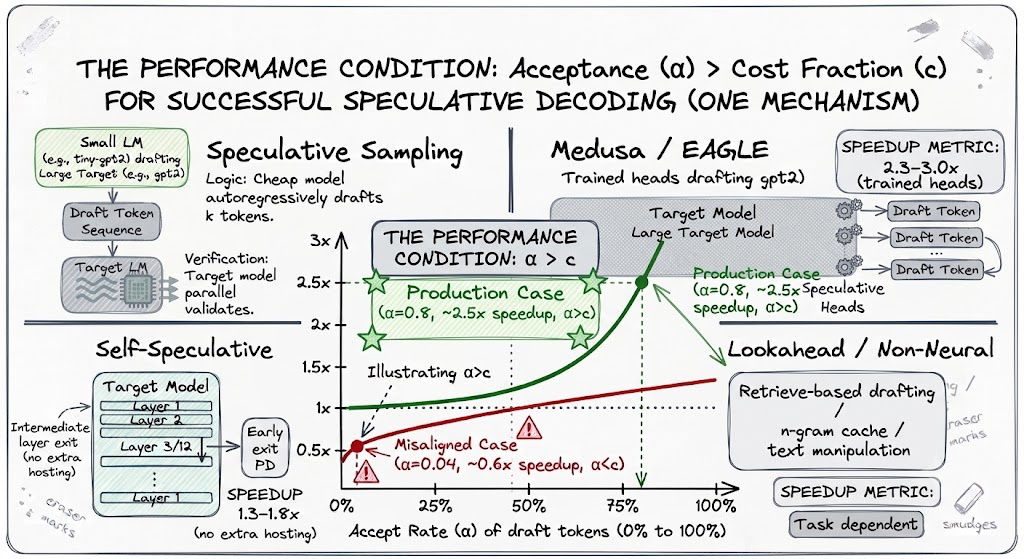
Mathematical Speedup Condition ($\alpha > c$)
Let $c$ represent the ratio of draft model execution cost relative to target model execution cost per token:
$$c = \frac{\text{Cost}_{\text{draft}}}{\text{Cost}_{\text{target}}}$$
Let $\alpha$ represent the average token acceptance rate across speculative steps. The theoretical speedup factor $S$ relative to standard autoregressive execution is modeled as:
$$S \approx \frac{1 + k \cdot \alpha}{1 + k \cdot c}$$
To achieve a net speedup ($S > 1$), the pipeline must satisfy the inequality:
$$\alpha > c$$
If candidate acceptance falls below the cost threshold ($\alpha < c$), the computational overhead of draft generation and verification outpaces the benefits of sequence amortization, leading to increased latency.
Measured Experimental Results
Evaluating speculative decoding across unaligned draft configurations demonstrates the real-world operational impact of the $\alpha > c$ constraint:
| Draft Configuration | Relative Cost Fraction ($c$) | Acceptance Rate ($\alpha$) | Speedup ($k=1$) | Speedup ($k=3$) | Net Performance Impact |
|---|---|---|---|---|---|
tiny-gpt2 (10M vs 124M) | ~0.08 | 4.0% | 0.68× | 0.44× | Performance Penalty |
gpt2 Early-Exit (Layer 3/12) | ~0.25 | 12.0% | 0.68× | 0.38× | Performance Penalty |
gpt2 Early-Exit (Layer 10/12) | ~0.83 | 29.0% | 0.38× | 0.35× | Performance Penalty |
    Speedup (x Baseline)
    1.2x ┼─────────────────────────────────────────────────── (Break-even: 1.0x)
    1.0x ┼───────────────────────────────────────────────────
    0.8x ┼───── Top Performance (k=1, alpha=4%..12%): ~0.68x
    0.6x ┼───────────────────────────────────────────────────
    0.4x ┼───────────────── Top Performance (k=3): ~0.35x..0.44x
    0.2x ┼───────────────────────────────────────────────────
         └───────┬───────────────┬───────────────┬───────────
               k=1             k=2             k=3
System Failure Modes
- Distributional Mismatch ($\alpha < c$): Using an unaligned draft model causes frequent rejection steps, incurring severe draft-overhead penalties.
- High Batch Aggregation ($B \gg 1$): At high query volumes, hardware compute pipelines shift from memory-bound to compute-bound states. Under these conditions, speculative verification offers diminishing latency returns while increasing total FLOP utilization.
- High-Entropy Generation Tasks: Tasks with high logical complexity (e.g., code generation or complex mathematical reasoning) exhibit lower acceptance rates ($\alpha$), reducing maximum attainable sequence extensions per step.
---
Conclusion
Speculative decoding is a powerful technique for accelerating single-stream LLM inference, but its benefits are fundamentally conditional. Achieving real-world speedups requires strict optimization of draft alignment ($\alpha$) relative to system cost ($c$). When deploying speculative pipelines in production systems, profile target-draft acceptance rates under actual workload distributions before enabling parallel verification logic.
---
References
- Leviathan, Y., Kalman, M., & Matias, Y. (2023). Fast Inference from Transformers via Speculative Decoding. International Conference on Machine Learning (ICML). arXiv:2211.17192
- Chen, C., Borgeaud, S., Zhou, G., Steiner, D., & Chen, Z. (2023). Accelerating Large Language Model Decoding with Speculative Sampling. arXiv preprint. arXiv:2302.01318
- Cai, T., Li, Y., Geng, Z., Peng, L., Li, F., & Xiao, W. (2024). Medusa: Simple LLM Inference Acceleration Framework with Multiple Decoding Heads. International Conference on Machine Learning (ICML). arXiv:2401.10774
- Li, Y., Wei, F., Zhang, C., & Zhang, H. (2024). EAGLE: Speculative Sampling Requires Rethinking Feature Uncertainty. International Conference on Machine Learning (ICML). arXiv:2401.15077
- Zhang, J., Wang, J., Huang, H., Chen, Y., & Zhou, W. (2023). Self-Speculative Decoding with Self-Draft and Self-Verification. Empirical Methods in Natural Language Processing (EMNLP). arXiv:2311.08466
- Fu, Y., Bailis, P., Stoica, I., & Zhang, H. (2024). Break the Sequential Dependency of LLM Inference Using Lookahead Decoding. arXiv preprint. arXiv:2402.02057