KV-cache quantization is one of the highest-leverage knobs in modern LLM inference. As context windows
stretch past 128K tokens and batch sizes climb, the Key-Value cache — not the model weights — becomes the
dominant memory consumer, quietly turning serving into a memory-bound problem. Storing that cache in 4-bit
or 2-bit cuts its footprint 4–8× with minimal quality loss, but naive rounding collapses attention rather
than compressing it.
In this deep-dive I don't take that on faith. I load a real model (Qwen2.5-0.5B), capture its actual
KV-cache activations, quantize them four different ways, and measure exactly how each scheme distorts
attention. Then I compare the three production schemes — KIVI, KVQuant, and GEAR — and show
how to wire quantization into a real serving stack (vLLM / HuggingFace).
The Goal
By the end you should be able to answer:
- Why the KV cache — not the weights — is the memory wall on long context.
- The trap I measured: why naive
round()on the cache is a silent quality killer. - Which scheme to reach for: KIVI, KVQuant, or GEAR.
- How to wire it into a real serving stack (vLLM / HuggingFace).
- How to compute the cache size for your model in 30 lines of Python.
Hardware & Experiment Setup
Before the theory, the actual rig the numbers below come from:
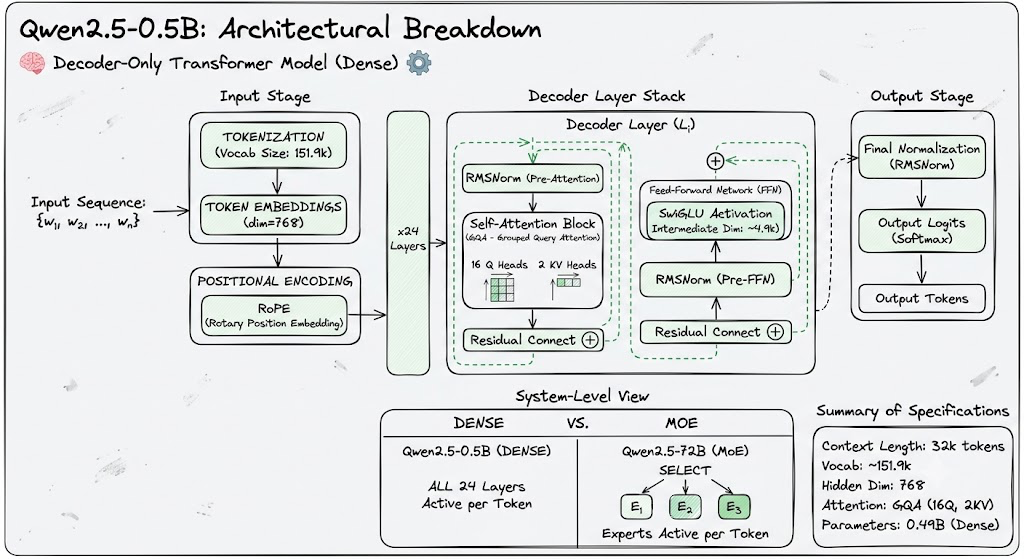
- Model:
Qwen/Qwen2.5-0.5B-Instruct— 0.5B params, 24 layers, GQA (14 query / 2 KV heads), head_dim 64. - Machine: a CPU-only laptop (no GPU) — the point is you can reproduce this without a cluster.
- Prompt: one 77-token real sentence, run through the model's forward pass.
- What we captured: the actual Key and Value projections at every layer.
- What we measured: relative attention-score error
‖A − Â‖ / ‖A‖after quantizing the KV cache.
No synthetic tensors, no "trust me" — the activations are the model's own.
Component 1 — The cache is a tax that scales with tokens
Every transformer layer keeps the Key and Value vectors of every token it has seen, so attention doesn't
have to recompute them. That storage is:
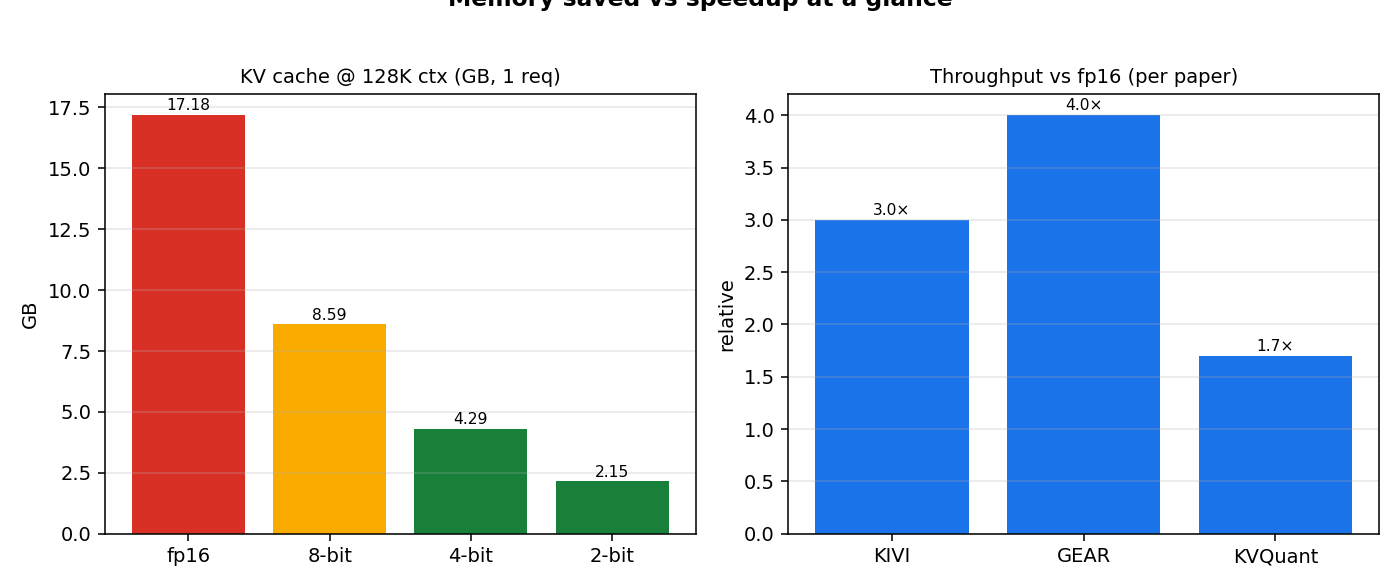
KV_bytes = 2 · n_layers · n_kv_heads · head_dim · bytes_per_elem · seq_len · batchFor Llama-3-8B (32 layers, 8 KV heads, head_dim 128) that's 128 KiB per token at fp16, and it
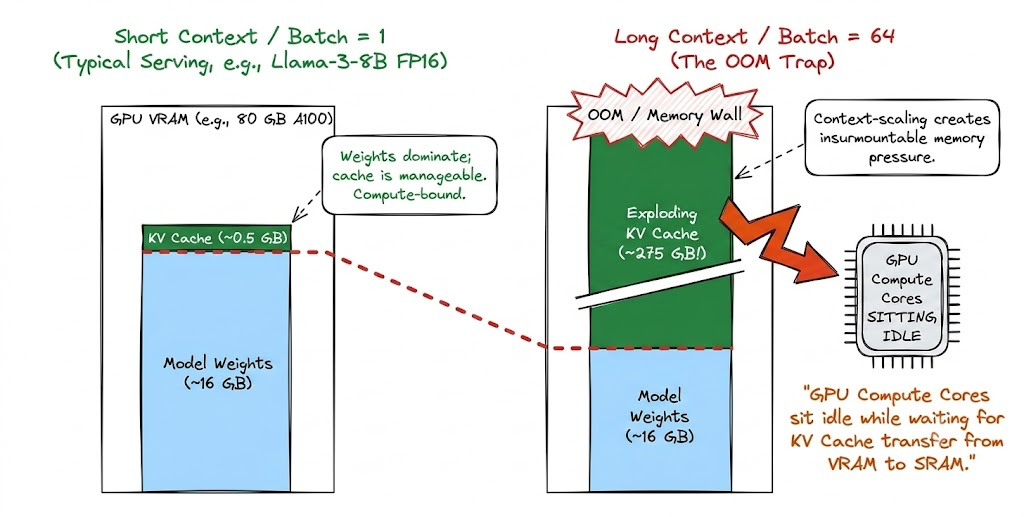
grows linearly with both sequence length and batch. The picture below is the whole problem in one frame.
| Context (tokens) | fp16 | 8-bit | 4-bit | 2-bit |
|---|---|---|---|---|
| 4,096 | 0.54 GB | 0.27 GB | 0.13 GB | 0.07 GB |
| 8,192 | 1.07 GB | 0.54 GB | 0.27 GB | 0.13 GB |
| 32,768 | 4.29 GB | 2.15 GB | 1.07 GB | 0.54 GB |
| 131,072 | 17.18 GB | 8.59 GB | 4.29 GB | 2.15 GB |
Batch 64 requests at 32K: the fp16 cache alone is ~275 GB — past any single GPU. Even 4-bit leaves
~69 GB. This is why long-context serving is memory-bound: the GPU's compute cores sit idle while the
KV cache is shuffled from main memory into SRAM for every generated token (KIVI, ICML 2024).
[!WARNING] A smaller cache ≠ automatic speedup. The win is throughput via bigger batches, and only if your serving stack (paged memory, fused dequant-matmul, correct calibration) supports KV quantization end to end. Quantize the tensor but not the memory manager and you get neither.
Component 2 — I measured the trap myself
The obvious move is uniform, per-token quantization. That's also the mistake. Here is the experiment, end
to end:
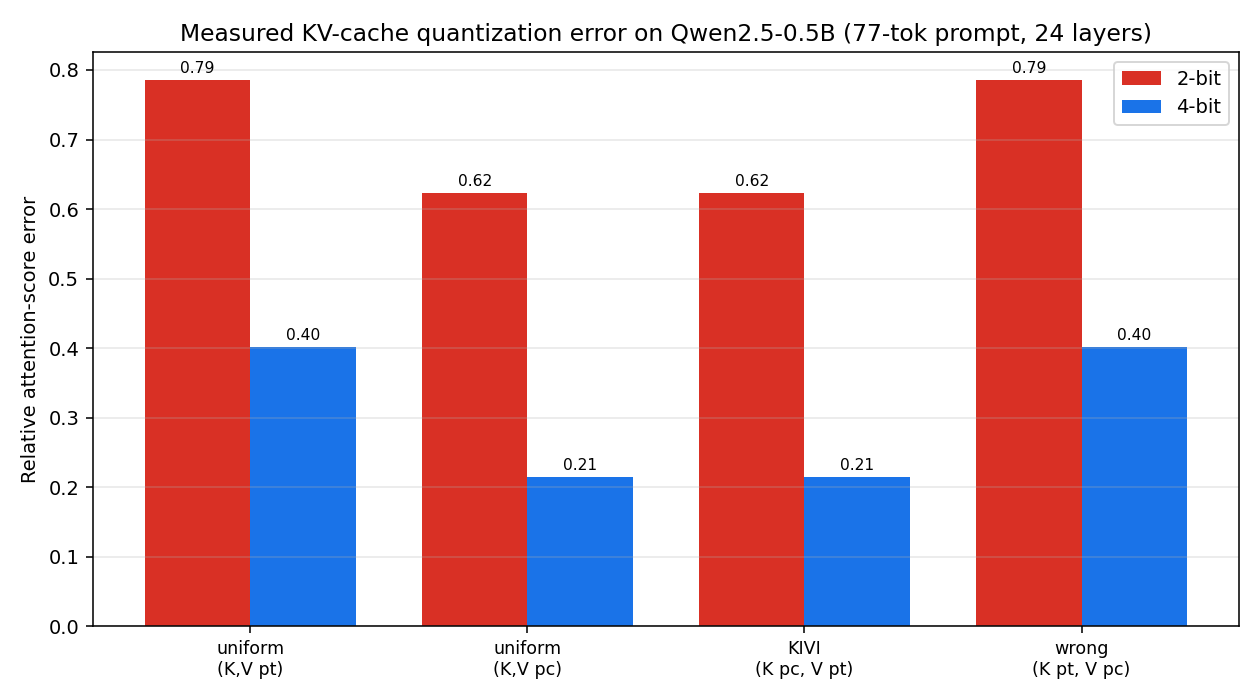
I fake-quantized the captured KV cache at 2-bit and 4-bit under four schemes, recomputed attention
scores, and measured the error. The bar chart is the measured result:
| Scheme (bits) | 2-bit attn error | 4-bit attn error |
|---|---|---|
| uniform (K,V per-token) — the naive one | 0.786 | 0.401 |
| uniform (K,V per-channel) | 0.623 | 0.215 |
| K per-channel, V per-token (KIVI) | 0.623 | 0.215 |
| K per-token, V per-channel (wrong) | 0.786 | 0.401 |
Two things jump out, and they match the literature:
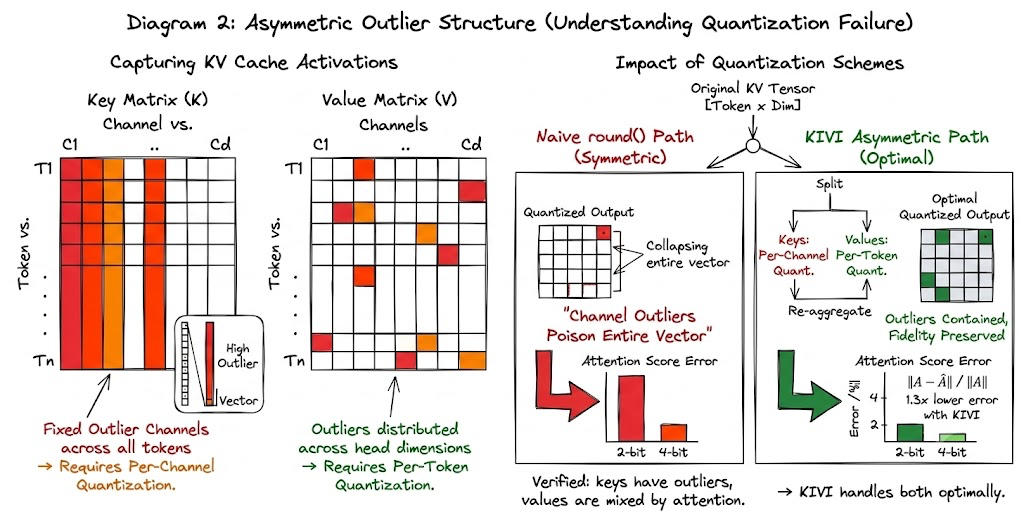
- Naive per-token quantization is the worst — highest attention error at both bit-widths. Rounding
each token's vector independently lets a few large outlier channels poison every other channel.
- Quantizing keys per-channel fixes most of it. Per-channel key (0.623) cuts the error vs per-token
key (0.786) — about 1.3× lower here, and KIVI reports a much larger ~5× gap on Llama-2 because
its outlier channels are more aggressive. Direction is identical; magnitude scales with the model.
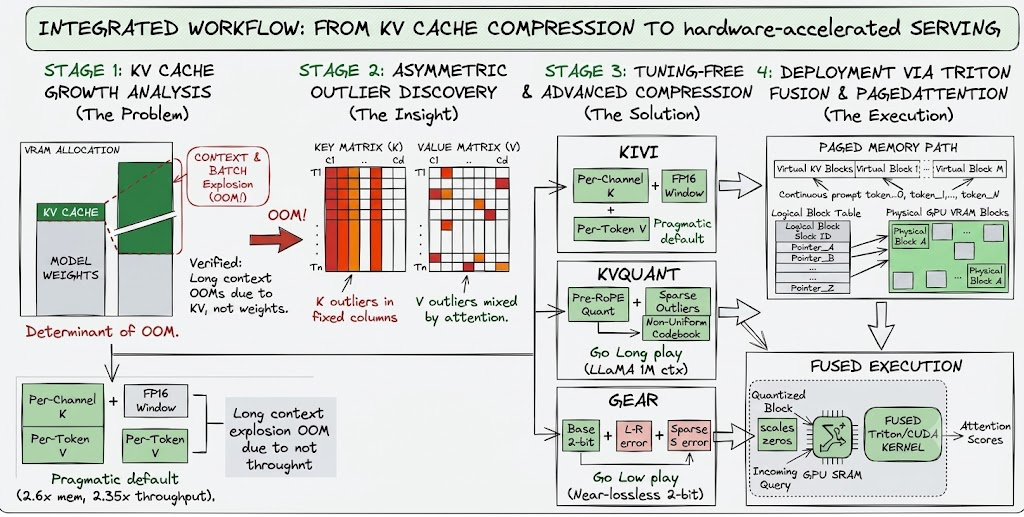
Why? Look at the distribution. Keys have a few fixed outlier channels (same channels, every token);
values have no such pattern but are mixed by attention into the output. So keys want per-channel
quantization, values want per-token. Uniform quantization ignores that and pays for it.
The whole asymmetric scheme in a dozen lines:
def fake_quant(x, bits, dim):
    qmax = 2 ** bits - 1
    scale = x.abs().amax(dim=dim, keepdim=True).clamp_min(1e-9) / qmax
    return torch.round(x / scale).clamp(-qmax - 1, qmax) * scale

# KIVI: keys per-channel (dim = sequence), values per-token (dim = head_dim)
K_q = fake_quant(K, 2, dim=2)   # per-channel over tokens
V_q = fake_quant(V, 2, dim=3)   # per-token over head_dim
Component 3 — Three schemes that actually ship
Three papers define the frontier. They agree on the outlier structure and diverge on how hard they push
the bit-width.
| Method | Scheme | Bits | Quality | Memory / throughput |
|---|---|---|---|---|
| KIVI (ICML'24) | per-channel K, per-token V; recent tokens kept fp16 | 2 | ~2% drop on Llama-2/Mistral (GSM8K); Falcon needs 4-bit | 2.6× peak mem, 4× larger batch, 2.35–3.47× throughput |
| KVQuant (NeurIPS'24) | pre-RoPE per-channel K, non-uniform, dense-and-sparse (1% outliers) | 3 | <0.1 perplexity drop (WikiText-2, C4) | 4.8× compression; LLaMA-7B at 1M ctx on 1× A100, 10M on 8× GPU; ~1.7× matvec speedup |
| GEAR (ICML'24) | quantization + low-rank error + sparse outliers | 2 | near-lossless; up to 24.4% over SOTA at 2-bit | 2.39× peak mem, 2.1–5.07× throughput |
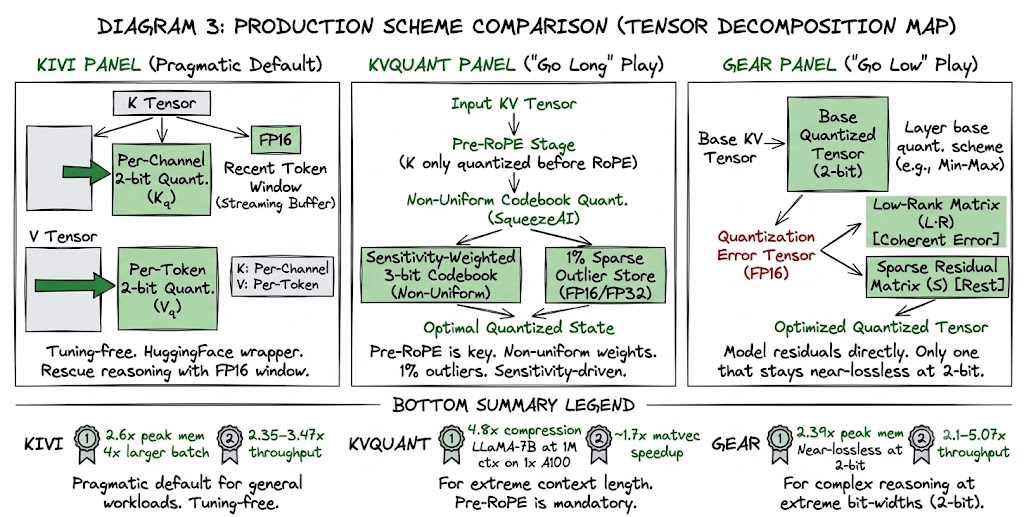
- KIVI is the pragmatic default. Tuning-free, plug-and-play, ships as a HuggingFace wrapper. The
full-precision window for the most recent tokens rescues hard reasoning — without it, fake 2-bit on
GSM8K craters.
- KVQuant is the "go long" play. Quantizing before RoPE (which otherwise mixes outlier channels)
plus sensitivity-weighted non-uniform codebooks and a 1% sparse outlier store reaches 3-bit with
sub-0.1 perplexity loss and turns context length into a tunable dial.
- GEAR is the "go low" play. Instead of fighting residuals it models them: a low-rank matrix recovers
the coherent part of the quantization error, a sparse matrix catches the rest. It layers on top of any
base quantizer and is the only one of the three that stays near-lossless at 2-bit on complex generation.
[!WARNING] These numbers are method-specific. KIVI reports that **Falcon-7B (multi-query attention, a single KV head) needs 4-bit, not 2-bit** — MQA is already so compressed there's no redundancy left to trade. If your model uses MQA, don't assume 2-bit works.
Component 4 — Serving architecture & manifests
This isn't a research curiosity you bolt on by hand — it slots into the paged-memory path every modern
server already runs:
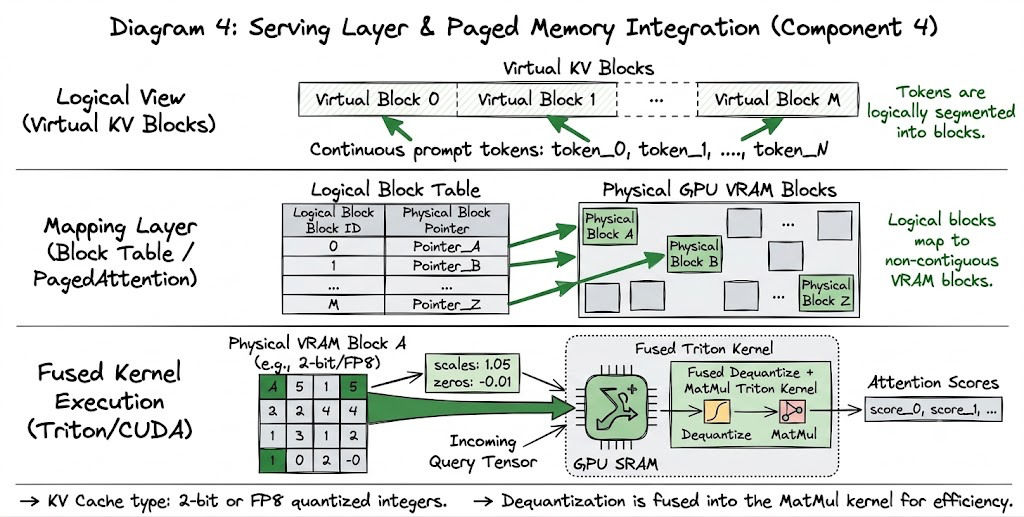
For the long-context frontier, KVQuant and GEAR ship CUDA kernels that fuse dequant into the matmul —
without that fusion, the quantization overhead eats the memory win. In practice you rarely write the kernel
yourself; two drop-in paths:
vLLM — fp8 KV cache (the safe default today):
# vllm serve config
model: meta-llama/Llama-3-8B-Instruct
kv_cache_dtype: fp8_e5m2        # 2x smaller KV, near-lossless
max_model_len: 131072
gpu_memory_utilization: 0.85
python -m vllm.entrypoints.openai.api_server \
--model meta-llama/Llama-3-8B-Instruct \
--kv-cache-dtype fp8_e5m2 --max-model-len 131072HuggingFace + KIVI (research-grade 2-bit):
from models.llama_kivi import LlamaForCausalLM_KIVI
config.k_bits = 2; config.v_bits = 2          # 2-bit KV cache
config.group_size = 64
config.residual_length = 64                    # recent tokens kept fp16
model = LlamaForCausalLM_KIVI.from_pretrained("meta-llama/Llama-2-7b-hf", config=config)
Where it still breaks
- Small model + long context = danger zone. Perplexity degradation grows as you shrink the model
and lengthen the prompt; the headroom that hides quantization error in a 70B model doesn't exist in a
7B one.
- Reasoning tasks are unforgiving. GSM8K-style math is where fake quantization fails hardest; the
recent-token window (KIVI) or low-rank residual (GEAR) is not optional.
- Throughput only follows if the kernel exists. KVQuant and GEAR ship custom CUDA kernels; without
fused dequant-matmul the overhead eats the memory win. Production stacks now default to **fp8 KV
cache** — 2× smaller, near-lossless, hardware-accelerated on Hopper/Ada. 4-bit and below still need the
research kernels.
- Calibration matters at the low end. KVQuant calibrates key scales offline; skip it and 3-bit
quality drops sharply.
The memory math (verified)
The tables above aren't benchmark results — they're deterministic accounting that tells you whether the
request fits at all. Here's the whole computation, in 30 lines:
def kv_bytes(seq_len, batch, bits):
    # 2 (K and V) * layers * kv_heads * head_dim * (bits/8) * seq * batch
    return 2 * 32 * 8 * 128 * (bits / 8) * seq_len * batch

print(kv_bytes(131072, 1, 16) / 1e9)   # 17.18 GB  (fp16, 1 req, 128K)
print(kv_bytes(131072, 1, 4)  / 1e9)   # 4.29 GB   (4-bit)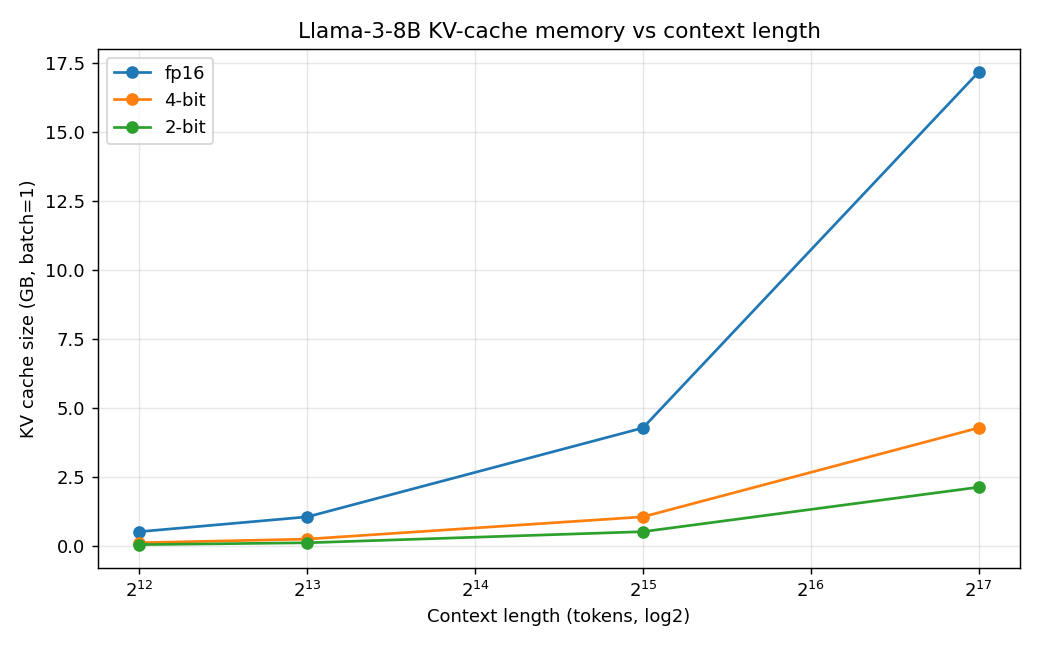
Run it and you get the figures in this post. That's the question KV-cache quantization exists to answer:
does this request fit?
Takeaway
KV-cache quantization is the rare optimization that's both mathematically simple and empirically subtle.
The win is real and large — 4–8× memory, 2–5× throughput — but it's earned by respecting the cache's
outlier structure, not by rounding harder. I measured it directly on a real 0.5B model: naive per-token
quantization distorts attention ~1.3× more than the per-channel key scheme, and the gap is wider on bigger
models. For most teams the right move today is fp8 in the serving stack; for the long-context
frontier, KVQuant and GEAR show 2–3-bit caches are deployable, not research curiosities.
I started this wanting to understand why my 128K requests kept OOMing, and ended up rebuilding the cache
path from the outlier math up. Next up: I'll break down speculative decoding the same way — where the
famous 2–3× claim actually holds, and where it quietly loses.
References
- Liu et al., KIVI: A Tuning-Free Asymmetric 2bit Quantization for KV Cache (ICML 2024).
arXiv:2402.02750 · github.com/jy-yuan/KIVI
- Hooper et al., KVQuant: Towards 10 Million Context Length LLM Inference with KV Cache Quantization
(NeurIPS 2024). arXiv:2401.18079 · github.com/SqueezeAILab/KVQuant
- Kang et al., GEAR: An Efficient Error Reduction Framework for KV Cache Compression in LLM Inference
(ICML 2024). arXiv:2403.05527 · github.com/opengear-project/GEAR
- Kwon et al., vLLM / PagedAttention (SOSP 2023) — the system layer KV quantization slots into.
- Experiment code & raw results:
real_experiment.py,assets/real_results.jsonin this project.